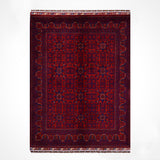
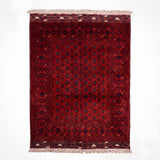
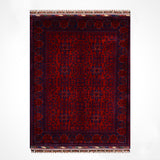
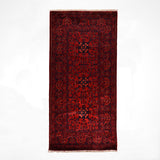
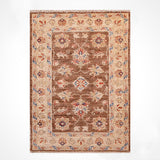
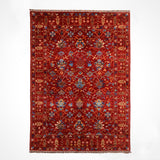

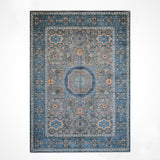
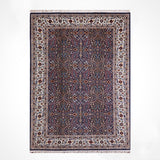

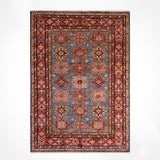
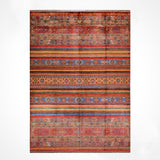
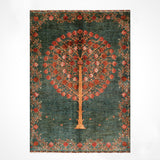
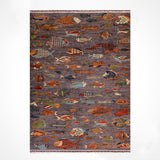
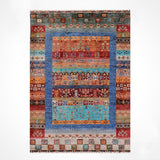
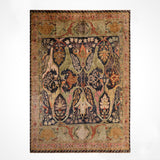

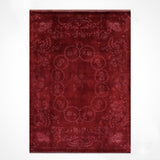
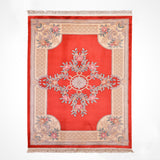


Hand-knotted rugs of naturally dyed wool carrying Uşak's pattern language: pastel models with cream and beige grounds and colourful models with blue, grey, green and red grounds.
Ushak Rugs


An Ushak rug is a wool rug knotted with the symmetrical knot, named after Uşak, a rug-weaving centre since the 15th century, and known for its medallion, star, large palmette and floral designs. This page has all our hand-knotted rugs carrying Uşak's pattern language: pastel models with cream and beige grounds and colourful models with blue, grey, green and red grounds. Each rug is one of a kind; its size, knot count and pile height are on the product page.
- 104hand-knotted Ushak-pattern rug
- 17,000 - 18,000 TLprice per m² for most rugs
- 0.5 - 16 m²size range, runners and round
- Free shipping14-day returns, 3 interest-free instalments
Ushak rug prices
In our collection, the price of an Ushak rug is determined almost entirely by its size. The price per m² is 18,000 TL for pastel models and 17,000 TL for colourful models. For example, a 170 x 240 cm (4.08 m²) pastel Ushak costs about 73,000 TL, and a 200 x 300 cm (6 m²) colourful model about 102,000 TL.
The most notable exception to this rule is Güllüce: in this model the price per m² is 30,000 TL.
| Size | Price range | Most rugs (median) |
|---|---|---|
| Up to 1.5 m² (60 x 90 - 100 x 150 cm)9,540 - 36,500 TL | 9,540 - 36,500 TL | 23,580 TL |
| ~2 m² (120 x 180 cm)25,670 - 43,200 TL | 25,670 - 43,200 TL | 38,080 TL |
| ~3 m² (150 x 200 cm)47,090 - 57,460 TL | 47,090 - 57,460 TL | 52,955 TL |
| ~4 m² (170 x 240 cm)68,510 - 123,396 TL | 68,510 - 123,396 TL | 72,810 TL |
| 5 - 6 m² (200 x 300 cm)79,390 - 177,900 TL | 79,390 - 177,900 TL | 105,570 TL |
| 7 - 9 m² (250 x 300 cm)112,200 - 219,300 TL | 112,200 - 219,300 TL | 134,460 TL |
| 10 m² and above159,800 - 296,400 TL | 159,800 - 296,400 TL | 173,060 TL |
| Runner (80 x 200 - 540 cm)24,820 - 78,370 TL | 24,820 - 78,370 TL | 35,190 TL |
Compiled from the prices of Ushak-pattern rugs in stock; each rug's current price is on its own page. The cash price can be split into 3 interest-free instalments.
Ushak rug models: pastel and colourful
The Ushak-pattern rugs in the collection fall into two colour families. Pastel models are woven with large palmettes and flowers on cream and beige grounds within a wide border; some of the rugs on this page belong to this family. In the colourful models the same palmette and floral layout is carried onto blue, grey, green, red or brown grounds.
| Pastel Ushak | Colourful Ushak | |
|---|---|---|
| Field | Cream, beige, light grey | Beige, blue, grey, red, green, turquoise |
| Motif colours | Dusty rose, light blue, brown | Orange, turquoise, red, yellow |
| Price per m² | 18,000 TL | 17,000 TL |
| Pile height | Mostly 4 mm | Mostly 5 mm |
| Best room for it | Light-coloured living rooms and bedrooms with simple furniture | Living room, study or entrance where the rug will be the focal point |
Values are compiled from the specifications of rugs in stock.

Colourful Ushak
1 - 16 m², runners, round The blue, grey, green and red-ground interpretation of Ushak-pattern rugs. Orange, turquoise and yellow in the motifs.
Sultani
1 - 16 m², runners, round The largest model in the Colourful Ushak family. In Binbirgece the palmettes are scattered over the field; in Floral, branches and flowers wrap the field from end to end.
Güllüce
5 - 10 m² The model with the most finely drawn motifs in Colourful Ushak.
Bird & Fish
1 - 10 m², runners Figurative models of the colourful family: birds, peacocks, fish and trees on red and blue grounds.Ushak rug patterns
Uşak's registration certificate lists two main types: Medallion and Star Ushaks. Some of the Ushak rugs that went to Europe came to be known by the names of the painters who painted them there. The table below helps you tell which family you are seeing when you look at an Ushak rug.
| Pattern | What you see when you look | Period and trace |
|---|---|---|
| Medallion Ushak | Round medallions on the central axis, pointed lobed medallions at the sides. On red-ground pieces the medallion is always navy; the pattern is cut off at the edge, as if it continued forever. | From the 16th century to the mid-18th century; lengths of up to 10 metres |
| Star Ushak | On a red ground, eight-pointed navy stars and small lozenge medallions are arranged in rows; the centre of the rug is not marked. | Medium-sized rugs, few exceeding 4 metres; the oldest examples date from the end of the 15th century |
| Lotto | A lattice of yellow arabesques and palmettes on a red, sometimes navy, ground. | It takes its name from the painter Lorenzo Lotto; in 16th- and 17th-century paintings |
| Holbein | The field is divided into squares with octagons inside; the border has interlace resembling Kufic script. | Named for appearing in the paintings of Hans Holbein (d. 1543) |
| White-ground: bird and çintamani | Ivory ground. In the bird type, pointed leaf motifs resembling birds; in çintamani, three dots and two wavy lines. | 16th and 17th centuries; the price register of 1640 mentions Selendi's rugs 'with crow designs on white' |
| Prayer rug | A mihrab arch with a hanging lamp inside; there are also double-mihrab examples. | Museum examples from the first half of the 17th century |
| Today's regional patterns | Medallion (sofra bucak), floral, cloud, scattered, leaf and sapanlı designs. | Still woven today at Uşak Municipality's Dokur Evi |
The definitions are based on Turkish Patent and Trademark Office geographical indication certificate no. 152, the 'Halı' entry of the TDV Encyclopaedia of Islam, and museum records.
The pastel models in our collection have no medallion or rows of stars: large palmettes and flowers are scattered freely over the field, framed by a wide cream border. The colourful models carry the same layout onto dark grounds. We explain the history and meaning of the patterns in our article What Is an Ushak Rug?
Features of Ushak rugs
The technical definition of Ushak rugs is written in the geographical indication specification. Below you can see the values in the specification side by side with the specifications of the rugs in our collection.
| Feature | Geographical indication specification | In our collection |
|---|---|---|
| Knot | Symmetrical knot (Ushak double knot) | Hand-tied knots |
| Pile height | 5 - 7 mm | 3 - 6 mm; mostly 4 mm in pastel, 5 mm in colourful |
| Knot yarn | 100% wool | Wool |
| Warp and weft | Wool or cotton | Cotton |
| Yarn | Hand-spun or kirman-spun yarn | Wool hand-spun with a kirman spindle |
| Dyes | Natural dyes or metal-complex dyes | Natural dyes |
| Colour scheme | Red, navy and bright yellow; green and blue as secondary colours, black in the outlines | Cream and beige in pastel; blue, grey, red and green in colourful |
The specification of each of our rugs states its total knot count, pile height and material.
Does Ushak rug have a geographical indication?
Yes. 'Uşak Halısı' is a designation of origin registered under no. 152 with the Turkish Patent and Trademark Office. The registration was obtained in 2012 by the Uşak Chamber of Commerce and Industry; its geographical boundary is Uşak.
For a designation of origin, at least one of the product's production, processing or other stages must take place within these boundaries (Industrial Property Law No. 6769, article 34). Inspection is carried out once a year by a three-person panel from the Uşak Chamber of Commerce, Uşak University and the Provincial Directorate of Culture and Tourism; it looks at knot count, knot, yarn, dye and motif.
The rugs in our collection are not woven in Uşak; they are hand-knotted pieces carrying Uşak's pattern language. That is why our product names say 'Ushak-pattern'. If you are looking for a geographically indicated Ushak rug, ask the seller for a document showing the rug was woven in Uşak.
How can you tell a hand-knotted Ushak rug?
Machine-made and loom rugs woven from fibres such as viscose or lyocell (TENCEL) are also sold under the name 'Ushak rug'. Check the weave type and material on the label, then check the rug itself:
- Turn the rug over. In a hand-knotted rug the pattern is also clear on the back and the knots can be seen one by one.
- Look at the fringe. The fringe is a continuation of the warp threads; it is not sewn on afterwards.
- Look at the field. Naturally dyed, hand-spun wool shows slight tonal variations (abrash).
- Read the specification. A rug that does not state its knot count, knot type and pile height is hard to compare with another.
A detailed checklist is in our article How to Tell an Original Hand-Knotted Rug, and a comparison of the two types in Hand-Knotted or Machine-Made?
Which size and colour?
- Living room: 6 - 8 m² (200 x 300 or 250 x 300 cm). The front legs of the sofas should rest on the rug.
- Bedroom: 4 - 6 m²; the rug is laid under the lower part of the bed, extending out on both sides.
- Entrance and hallway: 1 - 2 m² rugs or 80 cm wide runners.
In a room with light parquet and simple furniture, a pastel Ushak makes the space look airy. If you want the rug to be the focal point of the room, or if you have children or pets, models with densely coloured motifs show everyday marks less. Room-by-room size suggestions are in our guide What Size Rug Do I Need?
Why Art Doku Halı?
- 40 years of experienceRugs chosen with experience built in the wholesale rug trade.
- 100,000 m² in stockA total of 100,000 m² in stock across hand-knotted and machine-made rugs.
- One of a kind, true sizeEach rug's size, knot count and photos are on its own page.
- Free shippingFree across Türkiye and worldwide. Orders within Türkiye ship the same day.
- 14-day returnsSee the rug in your home; you can return an undamaged rug within 14 days.
- 3 interest-free instalmentsThe cash price can be split into 3 instalments; bank transfer payments get a 3% discount.
Frequently asked questions
Why are Ushak rugs famous?
In the 16th century Uşak was the centre of the golden age of Turkish rug weaving. Because the rugs went to Europe from the port of Izmir, they were also called 'Smyrna rugs' there; they appeared in Renaissance paintings, and some types became known by painters' names such as Lotto and Holbein.
Their fame continued in the following centuries: According to the TDV Encyclopaedia of Islam, in 1873 two thirds of the rugs sent abroad from Anatolia were Ushak rugs. Today historic Ushaks are displayed in collections such as the Metropolitan Museum, the Victoria and Albert, Berlin and the Museum of Turkish and Islamic Arts in Istanbul.
Where are Ushak rugs woven?
Historically, Ushak rugs were woven in the city of Uşak and surrounding villages; at the start of the 20th century there were 2,000 looms in the region. Today workshops such as Uşak Municipality's Dokur Evi continue this tradition.
Because the name 'Ushak Rug' is protected by a geographical indication, it is correct to call rugs woven outside Uşak 'Ushak-pattern'. The rugs in our collection are hand-knotted pieces carrying Uşak's pattern language; they are not woven in Uşak, which is why their product names say 'Ushak-pattern'.
What are the features of Ushak rugs?
According to the geographical indication specification, an Ushak rug:
- it is woven with the symmetrical knot (Ushak double knot),
- pile height is 5 - 7 mm, knot yarn is 100% wool,
- dyed with natural dyes or metal-complex dyes.
The classic colour scheme is red, navy and bright yellow. Their best-known designs are the Medallion and Star Ushaks.
What do Lotto and Holbein rugs mean?
Both are Ushak types known in Europe by the names of the painters who painted these rugs. A Lotto rug has a lattice pattern of yellow arabesques and palmettes on a red ground; it is named after the Italian painter Lorenzo Lotto. A Holbein rug, on the other hand, is a geometric type whose field is divided into squares with octagons inside; it takes its name from often appearing in the paintings of the German painter Hans Holbein.
Both types appear in 16th- and 17th-century paintings.
How can you tell if a rug is valuable?
First check whether the rug is hand-knotted: if the pattern is clear on the back, the knots can be seen one by one and the fringe is a continuation of the warp, it is hand-knotted. Then look at the following:
- Material and dye: hand-spun wool and natural dyes increase value.
- Condition: worn pile, moth damage or poor repairs reduce value.
Details in our article How to Tell a Quality Rug.
What determines the value of an antique Ushak rug?
An antique rug is generally accepted to be one more than 100 years old. The value of an antique Ushak is determined mostly by:
- Period: 16th- and 17th-century medallion, star or white-ground examples are museum quality.
- Documentation: being able to prove its age and region.
- Dye: whether natural dyes were used.
- Condition: the soundness of the pile, fringe and edges, and the quality of any previous repairs.
We explain how to recognise an old rug in our article What Is an Antique Rug?
Which room suits an Ushak rug?
An Ushak rug suits any room; the choice comes down to colour family and size. Pastel models with cream and beige grounds make light-coloured living rooms and bedrooms with simple furniture look airy. Colourful models with blue, red or green grounds suit living rooms, studies and entrances where the rug will be the focal point.
The most popular sizes are 6 - 8 m² for living rooms, 4 - 6 m² for bedrooms, and 80 cm wide runners for hallways.
Does a naturally dyed Ushak rug fade?
Direct sunlight affects every natural fibre over time; naturally dyed wool is no exception. If part of the rug is always in the sun, the tone of that area may lighten.
To prevent this, turn the rug 180 degrees every six months; the effects of sun and foot traffic are spread evenly. Use sheer curtains or drapes on windows that get direct midday sun. We explain what natural dye is and how it is made in our article What Is a Natural-Dyed Rug?
How do you clean an Ushak rug?
Vacuum once a week, in the direction of the pile with the rotating brush switched off. Blot spilled liquid with a clean cloth without rubbing; do not use bleach or whiteners.
For a deep clean, do not wash the rug at home; give it to a company that washes hand-knotted rugs and ask for it to be dried in the shade. Contact us before having it washed; we can arrange trusted washing for hand-knotted rugs bought from us. Methods for each type of stain are in our stain guide.
Is an Ushak kilim the same as an Ushak rug?
No. The rug is knotted and has a pile: each knot is tied to the warp one by one, and the cut ends form the pile on the surface. A kilim, by contrast, is a pileless flat weave; the pattern is formed by passing weft threads between the warps, so it is thinner and lighter.
The name protected by geographical indication is 'Uşak Halısı', and its definition covers the knotted pile rug. You can see our flat-woven pieces on our Kilims page.
Sort